
Posthuman Cinema
Ten cinépoèmes that playfully experiment with AI as a form of otherworldly alien intelligence.
dream pirates of the artificial creative intelligencia
Ten cinépoèmes that playfully experiment with AI as a form of otherworldly alien intelligence.
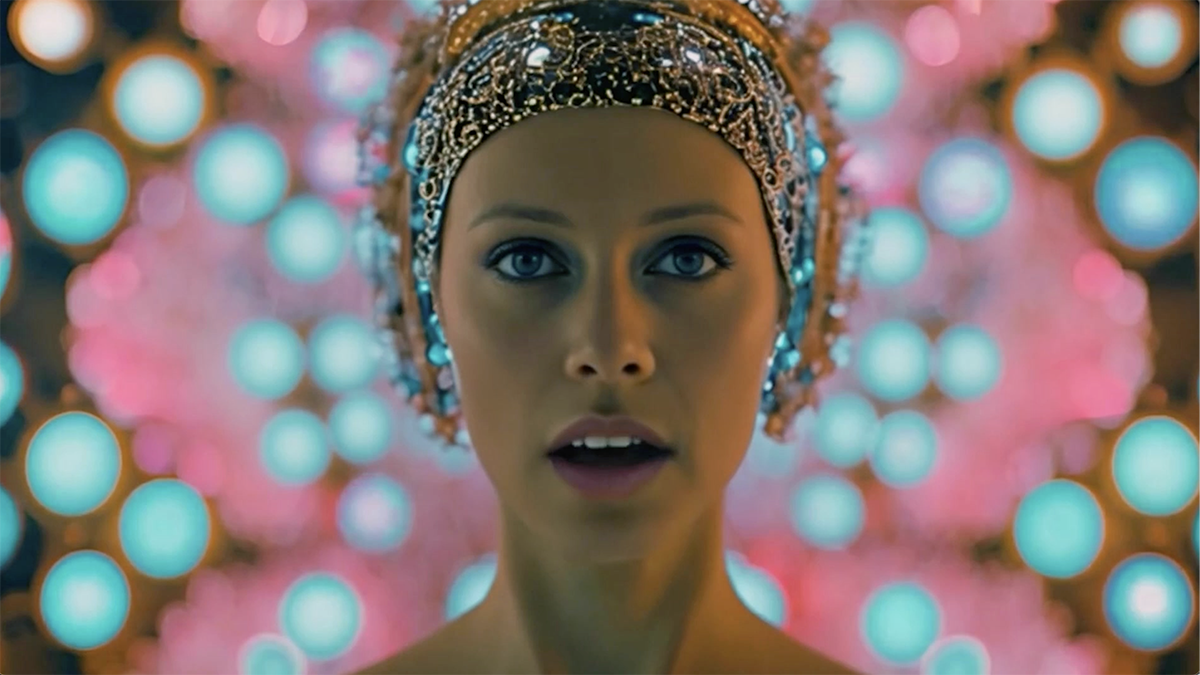
An AI-generated short in five movements — apparitions, transmissions, and the poetics of machine dreaming.
We’re an artist–research group working at the intersection of cinema history, experimental writing, and generative systems. Our practice treats AI as a collaborator, a constraint, and a mirror for human attention.
Mark Amerika has exhibited his art in many venues including the Whitney Biennial, the Denver Art Museum, ZKM, the Walker Art Center, and the American Museum of the Moving Image. His solo exhibitions have appeared all over the world including at the Institute of Contemporary Arts in London, the University of Hawaii Art Galleries, the Marlborough Gallery in Barcelona and the Norwegian Embassy in Havana and the Estudio Figueroa-Vives art gallery.
Amerika has had five early and/or mid-career retrospectives including the first two Internet art retrospectives ever produced (Tokyo and London). In 2009-2010, The National Museum of Contemporary Art in Athens, Greece, featured Amerika’s comprehensive retrospective exhibition entitled UNREALTIME including his groundbreaking works of Internet art GRAMMATRON and FILMTEXT as well as his feature-length work of mobile cinema, Immobilité. In 2012, Amerika released his transmedia narrative, Museum of Glitch Aesthetics (MOGA), a multi-platform net artwork commissioned by Abandon Normal Devices in conjunction with the London 2012 Olympic and Paralympic Games.
He is the author of thirteen books including My Life as an Artificial Creative Intelligence, the inaugural title in the “Sensing Media” series published in 2022 by Stanford University Press.
Will Luers is a digital artist and writer working at the intersection of AI cinema, recombinant narrative, and computational media. His practice explores how generative systems reshape storytelling, perception, and human-machine collaboration across multimodal and networked forms.
His work has been exhibited internationally at venues including the Electronic Literature Organization, FILE (Brazil), and ISEA. In 2016, his collaboration with Roger Dean and Hazel Smith, novelling, received the Robert Coover Award for Electronic Literature. Luers' artistic background spans experimental cinema, screenwriting, and database-driven video works. He received Best Screenplay at the Nantucket Film Festival in 2005 and developed the database documentary The Father Divine Project as part of a Vectors–NEH fellowship. Throughout these projects, his work emphasizes montage, generative processes, and the poetic tension between human intention and algorithmic systems.
He teaches digital cinema and generative media at Washington State University Vancouver and is the founding editor of The Digital Review, an international journal for digital art and literature. His curatorial and editorial work extends his ongoing investigation into AI, imagination, and emerging narrative forms.
Chad Mossholder is a BAFTA-nominated composer and sound artist renowned for his ability to seamlessly bridge the worlds of art and commercial creative endeavors. With a career spanning over two decades, his diverse portfolio encompasses experimental electronic music composition, audio/visual art installations, and the dynamic realm of video game music and sound design. His critically acclaimed and experimental electronic music project “Twine” has performed all over the world and has released six full length albums as well as numerous mini-albums and EP’s on such labels as Schematic, Hefty Records, Bip-Hop Records and Ghostly Records.
His sound designs span a diverse range of high-profile game titles including DOOM, DOOM Eternal, EverQuest, EverQuest II, Star Wars Galaxies and DC Universe Online.
For more than 20 years, Chad has maintained a fruitful collaboration with acclaimed artist and writer, Mark Amerika. Their collaborative works, including Immobilité, the first-ever feature length art film shot on a mobile phone, have graced prestigious exhibitions on a global scale, solidifying their presence within the international art scene.